Multi-Site Retail
Every location signed its own deal, and nobody kept the file.
That's how multi-site telecom spend quietly stops making sense.
Phone, Network & Cybersecurity for Multi-Site Retailers
Restaurant groups, franchise operators, dealerships, and retail chains run on systems that have to work identically at every location — and usually do not. Gateway defines what your locations actually need, runs competing bids across 200+ providers, and manages the provider you choose through delivery — at no cost to you.
Every Minute the Register Is Down
Payment outages aren't rare events. Most chains have several a year.
What Multi-Location Retail Technology Has to Get Right
Multi-site retail has a problem single-location businesses never face: every store is its own small technology deployment, and left alone they drift. One location has fiber, another has cable, a third is on a consumer plan a regional manager set up in a hurry. Different providers, different equipment, different bills, different failure modes, and nobody who knows what is installed where. Meanwhile everything that generates revenue depends on that connection: point of sale, card processing, loyalty and app orders, inventory, digital signage, cameras, and the phone customers still use to ask whether you have the item. The technology to make this consistent exists. The difficulty is that most chains are sold it store by store, by whoever knocked on that particular door.
- Point of sale and payment uptime
- Standardized internet at every store
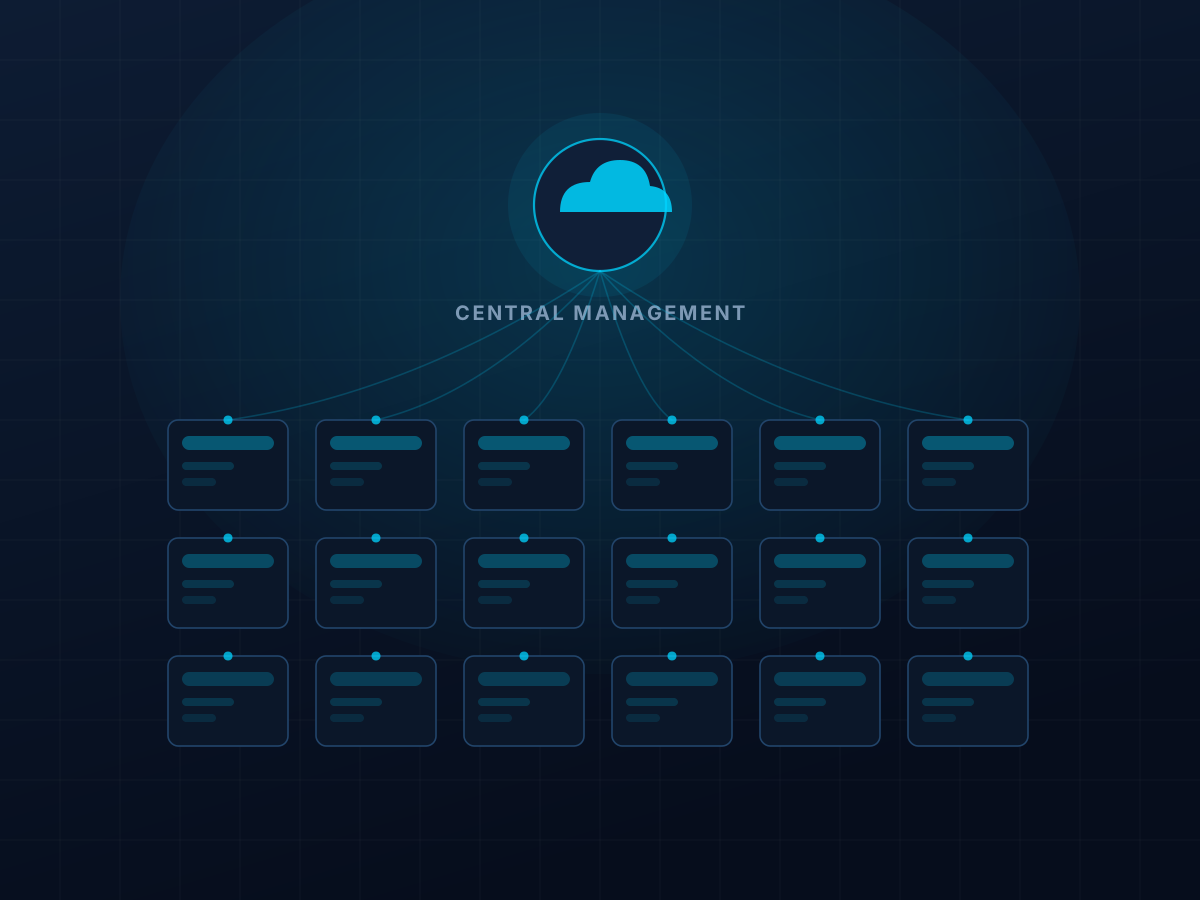
- SD-WAN with central policy management
- Cellular failover per location
- Payment segmentation and guest separation
- Guest Wi-Fi with captive portal
- One cloud phone system across all sites
- Store-to-store and store-to-HQ calling
- Paging, music, and drive-thru audio
- Camera and IoT bandwidth planning
- New store turn-up coordination
- Ransomware protection and MDR
- Bill consolidation across locations
- Multi-location telecom bill audit
What a Register Going Down Actually Costs a Store
Retail downtime prices itself immediately and publicly. When the connection drops, registers stop taking cards, app orders stop arriving, and there is a line of people watching it happen. A single store offline for two hours on a Saturday is a number you can calculate from your own daily average, and it is almost always larger than what cellular backup would have cost at that location for the entire year.
The costs that compound are quieter. A store on a consumer-grade connection that degrades every evening at peak. Card transactions taking eight seconds instead of two, multiplied across a shift, turning into lines nobody realizes could be shorter. Guest Wi-Fi sharing a circuit with the point of sale, so a busy dining room slows down payment. None of it generates a support ticket, because nothing is technically broken.
Then there is the security question, and in retail it has a specific shape: card data. A flat store network where the point of sale, the guest Wi-Fi, the cameras, and the manager's laptop all share one segment is both a compliance problem and the most common way retail breaches begin. Segmentation is not expensive, and it is dramatically cheaper implemented during a rollout you are already doing than as an emergency after an incident or a failed assessment.
How We Run a Multi-Site Retail Technology Selection
Most bad multi-site decisions get made one store at a time, which is exactly how a chain ends up with nine providers and no standard. This is the process we use instead, and it costs you nothing.
Discovery
We inventory every location: what is installed, who provides it, what it costs, and when each contract ends. That inventory alone usually surprises people, and it is the one thing no single vendor will ever build for you.
Competitive Bid
Your requirement goes to providers that can serve the whole footprint, plus the regional carriers that reach the addresses the national providers cannot. You get two to three real proposals covering every store, not a patchwork assembled after the fact.
Negotiation and Review
We compare pricing, service levels, term length, and new-location provisioning side by side, then negotiate the footprint as a portfolio rather than store by store. You choose. What we're paid never decides which one we recommend.
Delivery Management
The provider performs the site surveys, installation, and cutovers. We sequence the rollout, hold them to the schedule across every location, and stay engaged through new store openings, true-ups, and renewals.
What a Multi-Site Retail Technology Project Covers
Retail rollouts rarely stay in one lane. Once the circuits are on the table, the network, the phones, and the security around the payment environment come with them.
Store Connectivity
Standardized primary internet at every location, sized for what the store actually runs, with cellular or secondary-circuit failover so payment keeps working when the primary drops.
SD-WAN and Central Management
One policy applied everywhere, traffic prioritized so point of sale and payment outrank guest Wi-Fi and overnight backups, and new locations provisioned from a template instead of improvised on opening week.
Voice and Customer Contact
A single cloud phone system across all locations, store-to-store and store-to-office calling, centralized after-hours handling, and routing that gets a customer to a person rather than a full voicemail box. Store phones go unanswered for a reason — the staff are with customers — so an AI voice agent that handles hours, stock checks, and order status across every location is often worth more than any amount of routing cleverness, and it answers the same way at store forty as it does at store one.
Payment Segmentation and Security
The payment environment separated from guest Wi-Fi, cameras, and back office, plus ransomware protection and managed detection across every site rather than only at headquarters.
Guest Wi-Fi and In-Store Systems
Captive portal, bandwidth limits that protect the payment path, and planning for cameras, digital signage, kiosks, and drive-thru audio before they all contend for the same circuit.
Telecom Expense Management
One consolidated view of every location's bills, recovery of billing errors, and cleanup of service still billing at stores you closed or relocated.
Do You Need SD-WAN at Every Store, or Just Better Circuits?
This is worth settling before anyone books a demo, because it is where multi-site retailers most often overspend. A fully managed SD-WAN deployment at forty locations and a standardized circuit refresh with cellular backup at forty locations are very different monthly numbers, and both get pitched as the same modernization.
The dividing line is usually how much has to be centrally controlled. If each store is essentially independent — the point of sale talks to a payment processor, staff use cloud apps, nothing routes back to a data center — then a reliable circuit, a competent firewall, and automatic cellular failover may cover it entirely. The second test is traffic contention: if payment, guest Wi-Fi, cameras, and signage compete on one connection and payment keeps losing, prioritization is what SD-WAN actually buys. The third is rate of change — once you open, remodel, or relocate several stores a year, central provisioning stops being a luxury and starts saving real labor.
There is a middle option most vendors will not volunteer. You can run the full managed stack at your highest-volume locations and a simpler standardized build everywhere else, rather than licensing every address at the same tier. For a forty-store group where eight locations drive most of the revenue, that structure changes the three-year number considerably.
We will tell you when you do not need SD-WAN everywhere, even though the smaller deal pays us less. The goal is a footprint you can actually manage, not the largest contract available.
Rollout Sequencing, New Store Turn-Ups, and What Happens When a Store Goes Offline
Rollouts get sequenced before they get quoted. Forty locations do not cut over on one weekend, and any vendor who suggests otherwise has never managed a retail migration. We phase it: a pilot store first to prove the build, then a wave large enough to learn from, then the remainder, with existing service running in parallel at each address until the new path is proven there. Stores cut over outside trading hours, which in restaurants and convenience means overnight rather than Saturday morning.
New store turn-ups quietly determine whether the whole program was worth doing. The questions to ask any provider are how long from signed lease to working circuit, and what happens when the building is not already served. A standard build, a template configuration, and a named person who owns the turn-up reduce a new location to a checklist. Without that, every opening becomes a scramble and the store trades its first week on a hotspot.
Then there is the store that goes offline. Retail is the least forgiving environment for this, because the failure is visible to customers standing in front of you holding merchandise. Automatic cellular failover that keeps payment processing alive is inexpensive relative to a lost trading day, and it is the single highest-return item in most retail networks. We design that path per location during selection, because the right answer at a strip-mall unit and at a standalone building are not the same.
Retail Operators We Support
The right answer depends less on what you sell than on how many locations you run and how much revenue at each one depends on a live connection. A few patterns come up constantly across the metro.
Restaurant groups and franchisees
Payment, online ordering, delivery platform tablets, and drive-thru audio all riding one circuit, in an environment where a two-hour outage during dinner service is unrecoverable revenue.
Convenience and fuel
Long hours, thin on-site staffing, and payment systems that cannot pause. Remote management and dependable failover matter more here than anything else on the list.
Specialty retail chains
Seasonal volume swings, constant inventory lookups, and an increasing fulfillment role for online orders, all of which raise what a store's connection has to carry.
Dealerships and service groups
Multiple buildings on one campus, heavy phone volume into sales and service, management system integration, and customers who expect a call back the same day they left a message.
Fitness, salon, and appointment-based locations
Booking systems, member check-in, and door access all network-dependent, usually with no technical staff anywhere near the location when something stops working.
Grocery and food retail
Refrigeration monitoring, scale and label systems, and payment volume that makes any outage expensive and any card-data question serious.
We work with operators from a handful of locations up to regional and national chains — footprints that often span many states, with our deepest roots across St. Louis City and County, St. Charles County, Jefferson County, and the Metro East. If your operation does not look like any of the above, that is fine — the sourcing process is the same.
Multi-Site Retail Technology Questions We Get Asked
Do you install the circuits or the phone system yourselves?
No. The provider performs the site surveys, installation, and cutovers. Our role is defining the requirement, running competing bids, negotiating the contract, and managing that provider across every location so the rollout holds its schedule and someone answers when a store has a problem. The party evaluating the bids should not also be bidding.
What does Gateway charge for this?
Nothing, and you never pay more than you would going direct. The provider you select pays us once a contract is signed — a small monthly residual over the life of the agreement, not a lump sum. What we're paid never decides which one we recommend, which is precisely why a broker can tell you that thirty of your forty stores do not need the premium build, where a carrier representative cannot.
Can we get one provider across every location?
Sometimes, and it is worth testing, but a footprint spread across the metro and beyond frequently has addresses no single carrier serves well. The practical answer for most chains is a primary provider covering the bulk of locations and a small number of alternates for the addresses they cannot reach, managed under one program so it still behaves like a standard. Insisting on a single logo occasionally means accepting a worse circuit at a dozen stores.
Can we get one bill for all our stores?
Usually yes within a given provider, and consolidation is worth asking for during negotiation rather than afterward. Where a footprint spans multiple carriers, telecom expense management gives you a single consolidated view even when the invoices themselves stay separate. Either way the real win is not fewer envelopes — it is finally being able to see what each location costs and catch the ones still billing for service nobody uses.
What happens if a store loses internet?
With cellular failover configured, payment keeps processing and the store keeps trading, usually without staff noticing the switch. Without it, the register stops taking cards and the location falls back to whatever manual process it can improvise. Failover is the highest-return item in most retail networks precisely because the alternative is so visible to customers.
Do we need cellular backup at every location?
In most retail footprints, yes, and it is one of the few places we recommend spending everywhere rather than selectively. The monthly cost per location is small relative to a single lost trading day. The exceptions are locations where a genuinely diverse second wired circuit is available at similar cost, which is worth checking building by building rather than assuming.
How do you handle payment card segmentation?
By putting it in the requirement rather than leaving it to whoever installs the router. The payment environment gets its own segment, separated from guest Wi-Fi, cameras, signage, and back-office devices, with that separation applied consistently at every location rather than well at three stores and improvised at the rest. Your assessor defines what you must demonstrate; our job is making sure the providers bidding can deliver and document it.
Can guest Wi-Fi and the point of sale share one circuit?
They can share a circuit but should never share a network segment. Separate the traffic, cap what guests can consume, and prioritize payment so a full dining room streaming video never slows a card transaction. Where this goes wrong is a single flat network installed quickly at opening and never revisited, which is both a performance problem and a security one.
How long does it take to get a new store connected?
If the building is already served, a few weeks is typical, and a standing agreement with pre-negotiated pricing shortens it further because nobody has to re-quote. If the address needs construction, the timeline belongs to the carrier and the municipality and is commonly measured in months. The practical protection is to start serviceability checks at lease signing rather than at buildout, which is the single most common reason a store opens on a hotspot.
Our locations are all on different contracts ending at different times. Where do we start?
That is the normal starting condition, not a problem. We build the inventory first, including every renewal date, then group locations into waves by when they come available. Stores already out of term move first, which funds and de-risks the rest. Over eighteen to twenty-four months a scattered footprint converges on one standard without anyone paying an early termination fee to get there.
Can we keep our existing phone numbers?
Yes, and in multi-site retail this matters more than most operators expect, because store numbers are printed on signage, listed in every directory, and embedded in map listings. Numbers are portable and stay yours. We inventory every store line up front and sequence the ports location by location, with existing service staying live until the new path is confirmed working at that address.
Can all our locations share one phone system?
Yes, and it is usually one of the clearer wins in a multi-site refresh. One cloud platform gives every store its own local number while allowing extension dialing between locations, centralized after-hours and holiday handling, and one place to change a greeting across the whole chain instead of forty. It also ends the situation where each store's voicemail is configured differently and nobody at headquarters can hear any of it.
How long does a multi-site rollout take?
It depends far more on contract expirations and construction than on the technology. A footprint already out of term can move in a few months. A footprint with staggered renewals typically converges over a year or more, deliberately, because breaking contracts early rarely pays. We build the schedule around your renewal dates and your trading calendar, avoiding the seasons where nobody wants a technician in the store.
Do you work with franchisees, or only corporate?
Both. A multi-unit franchisee running six locations is a completely normal engagement, and franchisees often benefit most, because they carry brand technology requirements without corporate purchasing power behind them. Where a brand mandates specific systems or approved vendors, that becomes a constraint in the requirement rather than an obstacle — we source within it.
Can you help with locations outside Missouri?
Yes. We are based in St. Louis and source nationwide as an Intelisys channel partner, with access to 200+ providers. Multi-state footprints are where a broker earns the most, because no single carrier serves every address well and comparing them one location at a time is a full-time job nobody on your team has.
We are still under contract at most stores. Is it too early to talk?
No — it is the right time, and in multi-site it is arguably the only time. Building the inventory and mapping renewal dates takes weeks, and that work has to exist before you can negotiate anything as a portfolio. Twelve to six months ahead of your largest cluster of expirations is when you have leverage. We track the dates and come back at the right moment.
Put Every Location on One Standard
Bring a location list and a recent bill or two. In one 30-minute call we will tell you what is realistically available at your addresses, roughly what a standardized build should cost, and which stores are quietly overpaying right now.
Book a CallGet Competing Quotes
Tell us what you're running and we'll bring competing bids from 200+ providers — at no cost to you.
No cost, no obligation. Gateway Telecom Advisors is paid by the provider you select.