Logistics & Construction
Half your sites don't exist yet, and the other half are gravel.
Connectivity at a jobsite is a different problem than connectivity at an office.
Connectivity for Logistics, Warehousing & Construction
Warehouses, yards, and jobsites are the hardest places to put a reliable network, and the places where losing one costs the most. Scanners stop, dispatch goes dark, and a trailer sits. Gateway defines what your sites actually need, runs competing bids across 200+ providers, and manages the provider you choose through delivery — at no cost to you.
Rework Starts With a Bad Connection
Most of it traces back to information that never reached the field.
What Warehouse and Jobsite Connectivity Has to Get Right
This industry has a coverage problem that office-oriented vendors consistently underestimate. A warehouse is not an open floorplan — it is racking that absorbs signal, dock doors that open to nothing, a yard where drivers still need to scan, and a mezzanine office that was added later. A jobsite is worse: no permanent infrastructure, a footprint that changes weekly, and a trailer that has to run scheduling, plans, inspections, and payroll from the day the site opens. Meanwhile the dependence keeps climbing. Handheld scanners, telematics, yard cameras, ELD compliance data, digital plan sets, and daily reports all assume a live connection, and most of it was added one vendor at a time without anyone revisiting whether the underlying circuit could carry it. Research on connected fleet adoption has repeatedly found unstable connectivity to be the leading obstacle to scaling IoT in this sector — ahead of cost, ahead of integration.
- Warehouse and racking Wi-Fi coverage design
- Yard and dock-door coverage
- Temporary jobsite and trailer connectivity
- Scanner and handheld device reliability
- WMS and TMS connectivity
- Fleet telematics and IoT data backhaul
- EDI and customer portal uptime
- Multi-site and multi-yard SD-WAN
- Fixed wireless and cellular failover
- Dispatch and driver communications
- Security camera and access control bandwidth
- Ransomware protection and MDR
- Backup and disaster recovery
- Multi-site telecom bill audit
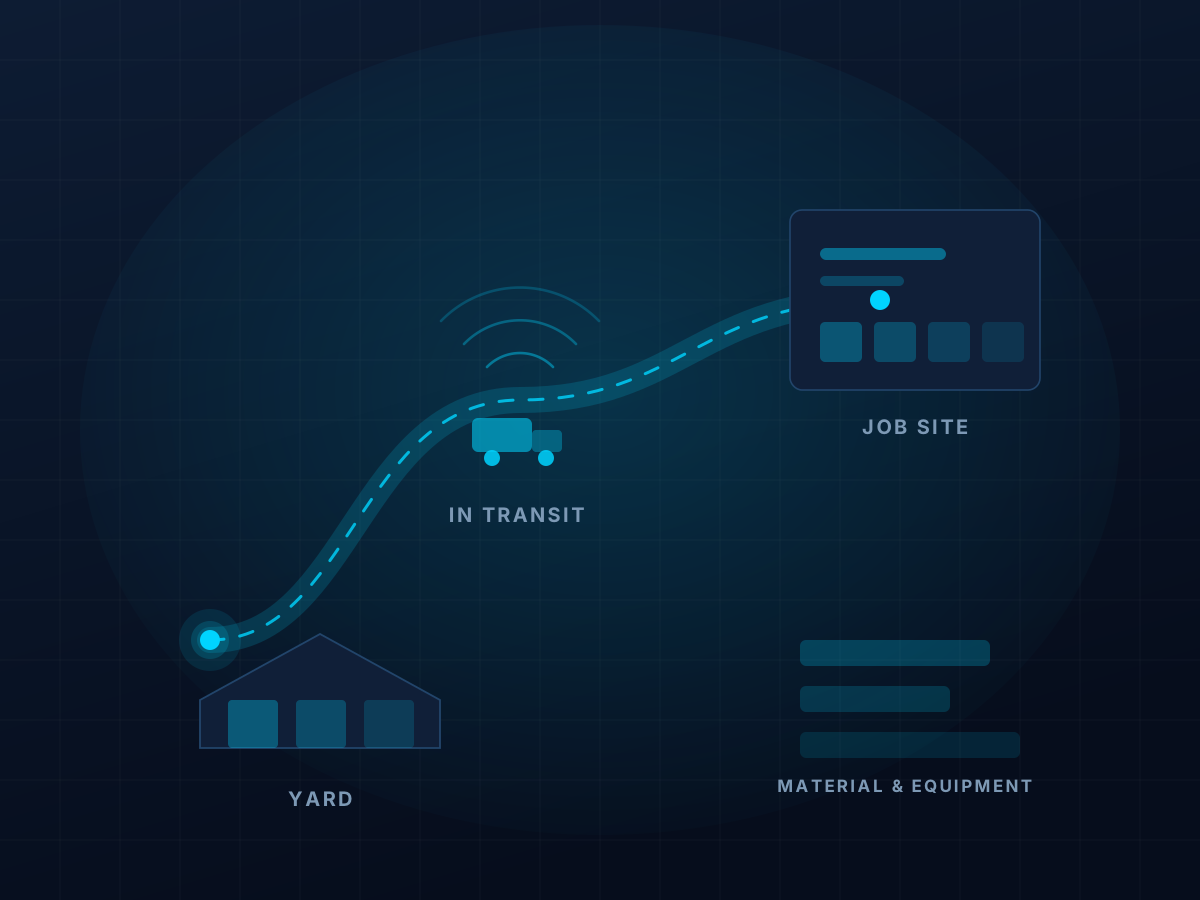
What a Dead Scanner or a Dark Jobsite Actually Costs
You can already price this better than any vendor can. You know your cost per hour of idle crew, per detained trailer, per missed dock appointment, and what a day of schedule slip does to a project with liquidated damages attached. That number is the honest budget for redundancy, and it is almost always larger than the monthly cost of a backup path. Most operations have simply never been shown the comparison, because connectivity gets bought as a utility rather than as the thing production depends on.
The quieter cost is degraded rather than down. A dead zone in aisle forty that puts pickers back on paper and creates a reconciliation problem at the end of the shift. Scanners that retry three times before a read lands, which nobody reports because it still eventually works. A yard camera that stopped uploading two months ago. A superintendent driving back to the trailer to pull up a drawing that should have loaded in the field. None of it appears on an invoice, which is exactly why it persists for years.
Then there is the security exposure, which in this sector is unusually broad. Logistics operations hold customer data, run EDI connections into their clients' systems, and increasingly connect telematics and yard equipment that was never designed to defend itself. Construction firms move plans, bids, contracts, and payment applications through email, which makes them a standing target for wire fraud and invoice interception. Cyber insurers have noticed. Renewal questionnaires now ask about multi-factor authentication, endpoint detection, and tested backups, which means your coverage terms increasingly set the technical requirement.
How We Run a Logistics or Construction Technology Selection
Most bad decisions here get made off a single vendor demo, where every option looks equally capable and nobody mentions that the coverage estimate assumed an empty building or that the fiber build to the yard is ninety days out. This is the process we use instead, and it costs you nothing.
Discovery
We map your warehouses, yards, offices, and active jobsites, what your WMS or project systems require, where scanners and handhelds actually have to work, and how long a site stays put. Nothing gets quoted before we understand how the operation runs at full racking and full crew.
Competitive Bid
Your requirement goes to the providers that genuinely serve your addresses — in an industrial park or on raw ground that is a far shorter list than the coverage maps suggest, and fixed wireless is often the only real answer. You get two to three real proposals with build timelines stated.
Negotiation and Review
We put pricing, service levels, term length, and install commitments side by side, then negotiate. You choose. What we're paid never decides which one we recommend.
Delivery Management
The provider performs the site survey, engineering, installation, and cutover. We hold them to the schedule, drive escalations when a build slips, and stay engaged through true-ups and renewals.
What a Logistics or Construction Technology Project Covers
These projects rarely stay in one lane. Once someone opens up coverage in the warehouse or connectivity at a jobsite, the circuits under it and the security around it tend to come with it.
Coverage Design
Wi-Fi engineered for racking, dock doors, cold storage, mezzanines, and yard operations rather than for an open office. Surveys done against a full building, not an empty one, because the difference between those two is where most coverage complaints originate.
Jobsite and Temporary Sites
Trailer connectivity that can be stood up in days rather than months, fixed wireless or cellular where no wireline exists, and contracts structured so you are not paying for a circuit at a site that closed last quarter.
Network and Connectivity
Dedicated internet at each facility, SD-WAN linking warehouses, yards, and headquarters, and automatic failover — which matters more here than almost anywhere, because industrial buildings sit at the end of long fiber runs where one backhoe takes out a shift.
Voice and Dispatch
Cloud phone systems that follow people who are not at a desk, dispatch routing that reaches a live person, mobile-first setups for field supervisors and drivers, and queueing for customer service and claims.
Security and Continuity
Ransomware protection, managed detection and response, email security against invoice and wire fraud, segmentation for cameras and telematics, and backup scoped against how long you could genuinely run without your WMS or project management system.
Telecom Expense Management
Invoice audit across every facility and site, recovery of billing errors, cleanup of circuits still billing at closed jobsites, and mobile line audits — where unused and inactive lines are close to universal in fleet-heavy operations.
Do You Need SD-WAN, or Just a Better Circuit and Real Coverage?
Worth settling before anyone books a demo, because the two look similar on a proposal and solve completely different problems. Plenty of distributors get quoted a fully managed SD-WAN deployment when the actual complaint — scanners dropping in the back half of the building — was a coverage design problem the WAN was never going to fix.
The dividing line is usually how many locations have to behave like one network. A single warehouse that needs reliable internet and a failover path does not need SD-WAN; it needs a genuinely dedicated circuit and a proper wireless survey. The second test is whether traffic has to be steered — if your WMS, voice, and camera uploads are competing on one pipe and the scanning traffic keeps losing, that prioritization is what SD-WAN is for. The third is rate of change: once you are opening yards or standing up jobsites regularly, central policy management stops being a luxury and becomes the only way to deploy a site in a week.
There is a middle option most vendors will not volunteer. You can run SD-WAN at the distribution center and the main yard where it earns its keep, and leave smaller terminals and temporary sites on fixed wireless or a simple circuit with cellular backup, rather than licensing every address at the same tier. For an operation with one DC, two cross-docks, and a rotating set of jobsites, that structure changes the three-year number considerably.
We will tell you when you do not need SD-WAN, even though the smaller deal pays us less. Getting that call wrong is the most expensive mistake in this category — in either direction.
Site Turn-Up, Legacy Lines, and What Happens When a Circuit Drops
Turn-up timing gets planned before anything gets quoted. A warehouse cutover is scheduled around the shipping schedule — a weekend or the gap between shifts — with existing service running in parallel until the new path is proven. A jobsite is the opposite problem: you need connectivity on day one, months before any carrier could build to raw ground, which is why fixed wireless and cellular are usually the right first answer with a wireline circuit following if the site justifies it. Any provider who will not commit to a turn-up window in writing before you sign has not thought about your schedule.
Legacy lines are the second surprise. Fire alarm dialers, elevator phones, gate and dock controls, guard shack lines, and the fax machine in the shipping office that one customer still uses are standard items in a facility cutover, and each has its own answer depending on the device and your inspection requirements. They can almost always be carried forward. The failure mode is rarely technical — nobody inventoried them, so they were never priced in. This is getting more urgent as carriers retire copper across the region and reprice the lines that remain, sometimes by an order of magnitude.
Then there is the circuit itself. A facility running cloud WMS, cloud voice, scanner traffic, and camera uploads over one connection has a single point of failure, and industrial buildings tend to sit at the end of long fiber runs where a cut two miles away takes you down. A designed failover path — a diverse second circuit where the building supports it, cellular or fixed wireless backup where it does not, and automatic cutover rather than someone manually reconnecting — is the difference between a five-minute blip and a lost shift. We establish that during selection, not after the first outage.
Operations We Support
The right answer depends less on what you move or build than on how many sites you run, how long they stay put, and how much of the work depends on a live connection. A few patterns come up constantly across the region.
Third-party logistics and warehousing
Scanner-dependent and Wi-Fi-dependent from dock to dock, often with customer systems to integrate against. Coverage design and circuit redundancy carry nearly all the load, and both are commonly undersized relative to actual volume.
Trucking and fleet operations
Dispatch has to reach drivers, telematics has to report, and the mobile bill is usually the least-audited line item in the company. Inactive and unused lines accumulate quietly in fleets and are among the fastest recoveries we find.
General contractors
A rotating portfolio of sites, each needing connectivity fast and none of it permanent. The recurring wins are rapid turn-up, contracts that end when the site does, and email security — because payment applications and change orders move through inboxes that fraudsters actively target.
Specialty trades and subcontractors
Usually a shop, a yard, and crews in the field. Mobile-first voice matters more than desk phones, and the office side is frequently running on a consumer-grade connection nobody has revisited since the business was half its size.
Cold storage and food distribution
Freezer environments are hostile to wireless and to hardware generally, and temperature monitoring and traceability requirements put uptime pressure on the network itself. Equipment selection matters more here than in a standard warehouse.
Freight brokers and forwarders
Phone-and-email businesses where the contact center is the operation. Call quality, queueing, recording, and CRM integration are the whole conversation, along with redundancy — an hour of dead phones is an hour of loads going to someone else.
We work with operations from a single warehouse or contractor's yard up to multi-site networks across Earth City, Hazelwood, Edwardsville, Fenton, Wentzville, St. Charles County, and the Metro East. If your operation does not look like any of the above, that is fine — the sourcing process is the same.
Logistics and Construction Questions We Get Asked
Do you install the network or phone system yourselves?
No. The provider performs the site survey, engineering, installation, and cutover. Our role is defining the requirement, running competing bids, negotiating the contract, and managing that provider so the project holds its schedule and someone answers when there is a problem. Keeping those two roles separate is the point — the company evaluating the bids should not be the company bidding.
What does Gateway charge for this?
Nothing, and you never pay more than you would going direct. The provider you select pays us once a contract is signed — a small monthly residual over the life of the agreement, not a lump sum. What we're paid never decides which one we recommend, which is precisely why a broker can give you a straight answer where a carrier representative cannot.
Can we actually get real bandwidth to our warehouse or yard?
More often than the last quote you received suggested. Industrial parks vary enormously building to building — fiber may terminate at the property line or two hundred feet short of it, and one provider's map will say served while another says construction required. Coverage maps are marketing; a serviceability check at your exact address is not. We run that check across every provider that reaches your area, including fixed wireless carriers that are frequently the fastest path to a yard or an outbuilding.
How fast can we get a jobsite trailer connected?
Days rather than months, if it is scoped correctly. Nobody is building fiber to raw ground on your schedule, so the practical answer is fixed wireless or a managed cellular solution sized for the crew and the systems that have to run. What matters just as much is the contract: a site that lasts fourteen months should not be on a three-year term. We structure it so the service ends when the site does.
Our scanners keep dropping in the back of the building. Is that the circuit?
Almost never. That is a coverage problem, and it is the most commonly misdiagnosed issue in warehousing — companies upgrade bandwidth twice before anyone surveys the building. Racking absorbs signal, and a design done against an empty warehouse does not survive full inventory. Cold storage and metal mezzanines make it worse. The fix is a proper survey against the building as it actually operates, and it usually costs a fraction of the bandwidth upgrade it replaces.
Our WMS cannot go down. How is cutover risk handled?
It gets planned before it gets quoted. Cutovers are scheduled around the shipping schedule — typically a weekend or between shifts — with the existing service running in parallel until the new path is proven, and a defined rollback if it is not. We hold the provider to that plan and stay on the escalation path through it. The risk in these projects is almost never the technology; it is a schedule nobody wrote down.
We have older analog lines at the facility. Do those have to change?
Usually they can be carried forward. Fire alarm dialers, elevator phones, gate and dock controls, and guard shack lines are standard items in a facility cutover, and the right approach depends on the device and what your inspection requirements say. We inventory them during discovery so they are priced into the proposal instead of discovered on cutover night. This is also where copper retirement bites — carriers are actively retiring copper across Missouri and Illinois and repricing what remains, and these are the lines sitting on it.
Do cameras and telematics really need to be separated from our network?
In most facilities, yes, and increasingly your insurer and your larger customers will ask about it. A flat network means an unpatched camera or a yard sensor sits on the same segment as your WMS and your finance systems. Segmentation does not require replacing equipment — it is a network design decision, and it is far cheaper to implement during a project you are already doing than as a standalone emergency after an incident.
What is cyber insurance actually asking for now?
Renewal questionnaires have gotten specific. Multi-factor authentication on remote access and email, endpoint detection and response rather than legacy antivirus, backups that are tested and isolated from the production network, and segmentation between office and operational systems are the recurring items. Answering no to several of them increasingly affects premium, deductible, or whether coverage is offered at all. Those questionnaires are worth reading before a technology project, because they tend to define the scope for you.
Will a cloud phone system work for dispatch and field crews?
It works well, and this is one of the clearer wins in the sector, because almost nobody in the operation is sitting at a desk. Mobile apps that ring the same number as the office handset, routing that follows a dispatcher rather than a location, and queueing so a customer calling about a load reaches someone instead of voicemail. An AI voice agent takes the calls dispatch should never have been fielding in the first place — where is my delivery, what time is the window, is the yard open tomorrow — and escalates anything that needs a decision. The endpoints still need specifying for the environment: loud ringers and visual indicators where a handset cannot be heard over equipment.
Can we keep our existing phone numbers?
Yes. Numbers are portable and they stay yours. What goes wrong is process rather than policy: a service address that no longer matches carrier records, an outstanding balance, or an account name that changed after an ownership transfer will all stall a port. We inventory every main line, DID, fax, and alarm line up front and sequence the port rather than flipping everything at once, and the existing service stays live until the new path is confirmed working.
Why do two quotes for the same circuit differ so much?
Because they are rarely the same circuit. A dedicated connection with a symmetrical committed rate and a service level agreement is a fundamentally different product from a shared broadband service marketed as business class, even when the advertised speed matches. Term length, install and construction charges, equipment rental, and what happens to the rate in year two account for most of the rest. Normalizing scope across competing bids is most of what we do, because two proposals at the same headline rate can differ substantially once everything is on the page.
What happens if the internet goes down at the facility?
With a designed failover path, very little. A secondary circuit or cellular backup takes over automatically and cloud voice reroutes to mobile apps, so scanning, dispatch, and order entry keep moving. Without one, a single fiber cut stops receiving, picking, and shipping at the same moment. The question worth asking any provider is not whether they offer redundancy but whether the backup path is genuinely diverse — a second circuit riding the same conduit into the building is not redundancy.
Do you work with single-site operations, or only multi-site networks?
Both. One warehouse or one contractor's yard is a perfectly normal engagement. Smaller operations frequently benefit most, because they have no internal IT function to run a competitive process and are the likeliest to be sitting on an auto-renewing contract nobody has examined in years.
Can you help with facilities and sites outside Missouri?
Yes. We are based in St. Louis and source nationwide as an Intelisys channel partner, with access to 200+ providers. Multi-state operations are common, and the value of a broker generally increases with footprint — no single carrier serves every one of your addresses well, and comparing them address by address is a full-time job nobody on your team has time for.
We are still under contract. Is it too early to talk?
No — it is the right time. Twelve to six months out is when you have leverage. Knowing your renewal date lets us run a real competitive process instead of accepting whatever arrives thirty days before an automatic renewal. We track the date and come back to you at the right moment.
Put Site-Ready Providers Side by Side
Bring your facilities, your uptime requirement, and a renewal date. In one 30-minute call we will tell you what is realistically available at your addresses, roughly what it should cost, and which providers can deliver into a warehouse or a jobsite without a surprise construction quote.
Book a CallGet Competing Quotes
Tell us what you're running and we'll bring competing bids from 200+ providers — at no cost to you.
No cost, no obligation. Gateway Telecom Advisors is paid by the provider you select.